

Can I Always Make Money With Combined Calendar Spread And Traddle
Double Calendars: The Low Volatility Trade with Two Peaks
Are you an option looking for a strategy designed for a lower-volatility environment?
Nov v, 2017

Photo by Getty Images
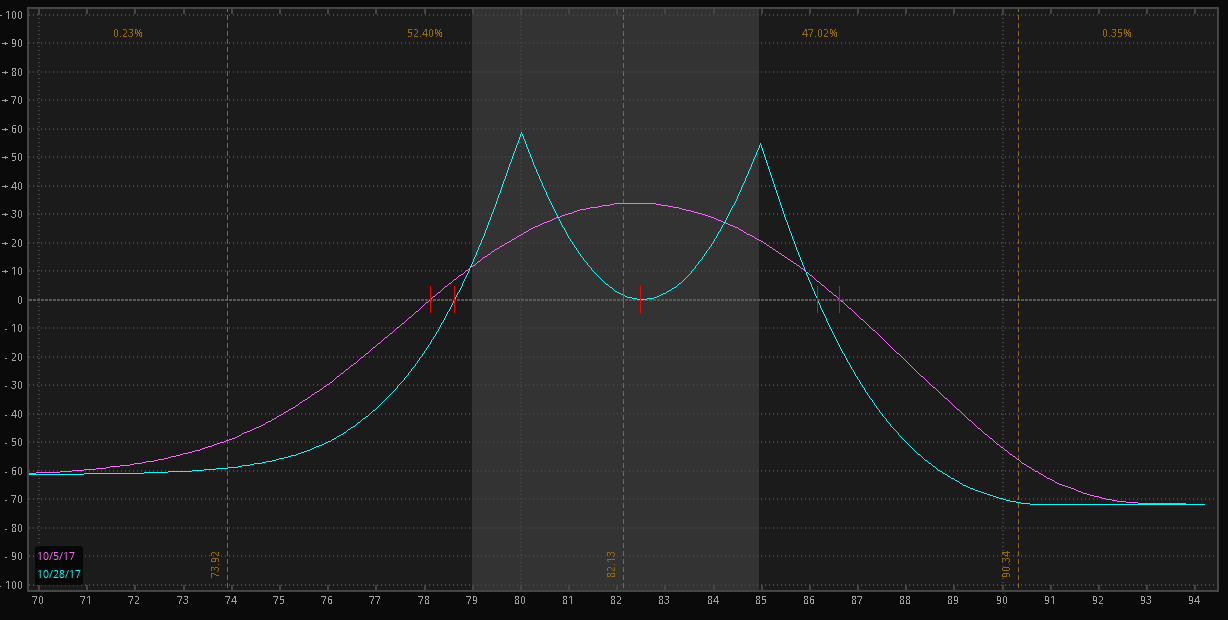
Are you an options trrader looking for a strategy designed for a lower-volatility environment where the underlying toll action gravitates toward either of 2 dissimilar strike prices? The double calendar could fit the nib. A double agenda has a wider breakeven range, and therefore a higher probability of making a profit, than an individual agenda. And yes, the chance/advantage graph looks kinda like a ii-peaked break span (figure ane, below). In a previous commodity, I discussed long calendar spreads. If you happened to miss that piece, here's a quick overview to become you lot up to speed: The double calendar is a combination of two calendar spreads. The strategy typically involves buying an out-of-the-coin (OTM) call calendar and an OTM put calendar around the current underlying price. The result is a trade that's similar to the neutral single calendar, but instead of having a turn a profit peak at merely 1 strike price, the double calendar has the potential for profit over a wider range of prices. Like the single agenda, the double agenda is designed to do good from an increase in implied volatility (Iv). A double calendar has two peaks or price points where the largest gains can be accomplished. The potential max gain can change based on fluctuations in unsaid volatility. The cost paid for the long double calendar is the risk involved in the spread. If you pay $0.72 for the double calendar, you are risking $72 per contract. With a long double calendar, traders typically wait to adjust or close each spread for a credit. The ideal scenario for this strategy would be an increase in volatility that coincides with the underlying moving toward either strike. As information technology moves closer to either strike, fourth dimension decay (theta) will increase, which also works in favor of the trade. This occurs considering the brusque near-term options tend to lose value at a faster charge per unit than the farther-term long options in the merchandise. The whorl values and calendar prices expand equally long as the underlying shares remain near either strike, and the implied volatility does not decrease past a significant amount. Figure i shows a typical double calendar risk/advantage graph with the optimal profitability beingness near either strike. The instance is ownership the Nov 17 $lxxx puts and $85 calls and selling the October 27 weekly $fourscore puts and $85 calls for a internet debit of $0.72. For more insight into potential strategies to consider effectually options expiration, this article might help. Figure 1: FROM Bong CURVE TO TWIN PEAKS. Example of the theoretical value of a double calendar with two weeks until expiration (purple line), and at expiration (bluish line). Note the modify in shape from a smoothen curve resembling a bell curve, to ane with ii peaks. Information source: CBOE. Chart source: the TD Ameritrade thinkorswim® platform. For illustrative purposes only. As shown, the ideal underlying prices for this double agenda are at the $80 and $85 strikes. The overall risk is capped at the $0.72 initiation toll, because the further-term options you are purchasing must be worth the aforementioned or more than than the shorter-term options you are selling due to the time value. If volatility rises from initiation levels, the profit potential should besides increment as long as the underlying shares are within a reasonable distance of either strike. Another potential benefit for long agenda trades is that although the initial run a risk is divers, the profit potential can increase if volatility rises. This is one reason initiating long calendars in a low-volatility environment tin exist beneficial. To wrap up, if you expect a move and volatility is depression, a double calendar may exist a strategy to consider for a wider range and a take a chance-defined downside. Delight retrieve that calendar, double agenda, and other multiple-leg option strategies like these can entail substantial transaction costs, including multiple commissions, which may touch on any potential return. These are advanced option strategies and oft involve greater risk, and more complex take chances, than basic options trades.
Doubling Calendars

Kickoff your email subscription
Recommended for you
Related Videos
Recommended for you
Content intended for educational/informational purposes merely. Not investment advice, or a recommendation of any security, strategy, or account type.
Exist certain to understand all risks involved with each strategy, including commission costs, before attempting to place any merchandise. Clients must consider all relevant risk factors, including their own personal financial situations, before trading.
AdChoices
Market volatility, volume, and system availability may filibuster account access and merchandise executions.
Past performance of a security or strategy does not guarantee future results or success.
Options are not suitable for all investors as the special risks inherent to options trading may expose investors to potentially rapid and substantial losses. Options trading subject to TD Ameritrade review and approval. Please read Characteristics and Risks of Standardized Options before investing in options.
Supporting documentation for any claims, comparisons, statistics, or other technical data will be supplied upon asking.
This is not an offer or solicitation in any jurisdiction where we are non authorized to do business or where such offering or solicitation would be reverse to the local laws and regulations of that jurisdiction, including, but not express to persons residing in Australia, Canada, Hong Kong, Nippon, Saudi Arabia, Singapore, United kingdom of great britain and northern ireland, and the countries of the European Matrimony.
TD Ameritrade, Inc., member FINRA/SIPC, a subsidiary of The Charles Schwab Corporation. TD Ameritrade is a trademark jointly owned past TD Ameritrade IP Visitor, Inc. and The Toronto-Rule Bank. © 2022 Charles Schwab & Co. Inc. All rights reserved.
Source: https://tickertape.tdameritrade.com/trading/double-calendar-options-16181
Posted by: lukerturitch.blogspot.com
0 Response to "Can I Always Make Money With Combined Calendar Spread And Traddle"
Post a Comment